Wednesday, October 10, 2007

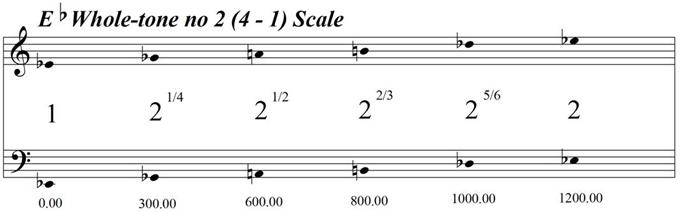
Scale of the Day: E Flat Whole-tone no 2 (4 - 1)

EFlatWholeToneNo2-4Minus1

The E Flat Whole-tone no 2 (4 - 1) Scale as one would find it on any conventionally tuned, equal tempered instrument. This is only the third pentatonic scale to appear as a "scale of the day." The lowered third (the second degree of this scale) makes for a diminished triad before the whole-steps round out the octave. The root, second, third and fifth degrees form the half-diminished chord even as this scale differs substantially from the traditional Locrian/half-diminished scale - suggesting a possible substitution in re-harmonizing the dominant chords of traditional melodies.

Tuesday, October 09, 2007

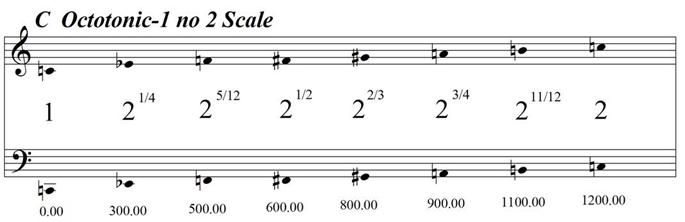
Scale of the Day: C Octotonic-1 no 2

COctotonic-1No2

The C Octotonic-1 no 2 Scale as one would find it on any conventionally tuned, equal tempered scale. This is another 7-note "octotonic" scale after the subtraction of the second degree.

Monday, October 08, 2007

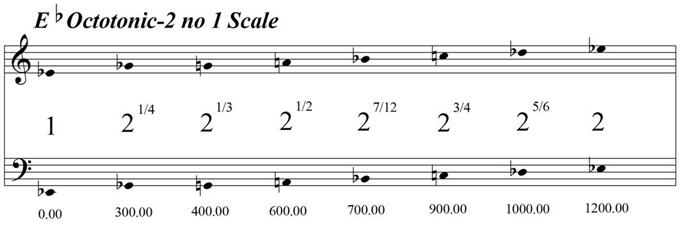
Scale of the Day: E Flat Octotonic-2 no 1

EFlatOctotonic-2No1

The E Flat Octotonic-2 no 1 Scale as one would find it on any conventionally tuned, equal tempered instrument. The subtractive process makes for a 7-note "octotonic" scale that - on piano at least - sits under the fingers like a Mixolydian with a raised second and augmented fourth. That Mixolydian-ness is cognitively noticeable.

Sunday, October 07, 2007

Viva Gerard

Washington Musica Viva presents: Charley Gerard/Carl Banner recital
@ St. Andrew's United Methodist Church and Day School, Edgewater, MD

Charley Gerard: alto saxophone
Carl Banner, PhD: piano

Cinq danses exotiques by Jean Francaix
Tango-Etudes by Astor Piazzolla
Dance by Darius Milhaud
Hot Sonate by Erwin Schulhoff
Tatumesque by Charley Gerard
Will You Love My Earth Kiss Tomorrow by Charley Gerard

With a muted, yet powerful tone and special attention toward phrasing and accent structure, Charley Gerard and Carl Banner opened these ears to a concert repertoire of jazz and dance influenced works with roots in the early twentieth century.

Opening with the pleasant Cinq danses exotiques by Jean Francaix, the soloist and accompanist established an early balance and lean rhythmic sensibility that carried throughout the afternoon. The tango music of Astor Piazzolla is a deservedly celebrated attraction that received an animated treatment. The music of Darius Milhaud was another draw as I haven't heard nearly enough Milhaud. Dance was just a wisp of a piece from a composer overdue for renewed interest. Gerard's own compositions were humor-laced pieces that make clear use of a variety of influences.

The music of Erwin Schulhoff was new to me, and particularly striking. Charley Gerard briefly touched upon the tragic circumstances of Schulhoff's short life as a jazz pianist in Germany of the 1930's as he introduced the piece. Hot Sonate hinted at what must be a vast treasure of music filled with rhythmic twists and melodic wit.

HurdAudio Rotation: Jenkins and Monk in Heaven

Ron Miles: Heaven. 2002. Sterling Circle Records: SC5151.

Ron Miles: trumpet
Bill Frisell: guitar

This improvising duo is balanced and tinged by a deep chemistry forged through long friendship and a history of multiple collaborations. It's a quiet, melodious project that is every bit as transcendent as its title would suggest. There's a seamlessness between the originals and covers - even when rendering an unmistakeably "true" take on Hank Williams' "Your Cheatin' Heart." The balance of creativity and musicianship runs deep and comes off so effortless as to feel unassuming.

Elliott Sharp: Sharp? Monk? Sharp! Monk! - Elliott Sharp Plays the Music of Thelonius Monk. 2006. Clean Feed: CFG001CD.

Elliott Sharp: acoustic guitar

There are moments when the angular melodies of these Monk tunes take surprising turns as Sharp coats them with unusual timbral variations from his Dell Arte Grande Bouche acoustic guitar. When "Well You Needn't" emerges with a tone similar to plucked, high pitched piano wire it's hard to suppress a smile. There's a wealth of smiles on this disc as Sharp brings a thoughtful and not overly solemn angle to Monk that highlights the joy of Monk's harmonic language and melodic sensibilities.

Leroy Jenkins: Themes and Improvisations on the Blues. 1994. CRI: CD 663.

Themes & Improvisations on the Blues (1986)
The Soldier String Quartet:
Laura Seaton: violin
David Soldier: violin
Ron Lawrence: viola
Mary Wooton: cello

Panorama 1 (1983)
Leroy Jenkins: violin
Henry Threadgill: flute
Don Byron: clarinet
Marty Ehrlich: bass clarinet
Vincent Chancey: french horn

Off Duty Dryad (1990)
Soldier String Quartet plus
Lindsey Horner: bass

Monkey on the Dragon (1989)
Leroy Jenkins: solo violin
Henry Threadgill: flute
Don Byron: clarinet
Marty Ehrlich: bass clarinet
Janet Grice: bassoon
Vincent Chancey: french horn
Frank Gordon: trumpet
Jeff Hoyer: trombone
Thurman Barker: traps
Myra Melford: piano
David Soldier: violin
Jane Henry: violin
Ron Lawrence: viola
Mary Wooton: cello
Lindsey Horner: bass
Tania Leon: conductor

The focus on this recording is Leroy Jenkins as composer for these four, vivid chamber works recorded in 1992. The fact that so many of the performers involved with this presentation have since recorded so many staggering works of their own can be at least partially attributed to their involvement with Leroy Jekins' music. The same qualities that make Jekins the improviser so compelling to listen to carry over into his written scores.

Probing Resonances - Marilyn Crispell/Mark Helias/Andrew Cyrille Trio at the Rose

Marilyn Crispell/Mark Helias/Andrew Cyrille Trio
Paul Lytton/Nate Wooley Duo
@ Rose Recital Hall, 4th Floor of Fisher-Bennet Hall, University of Pennsylvania, Philadelphia, PA

Marilyn Crispell: piano
Mark Helias: bass
Andrew Cyrille: drums

Paul Lytton: drums
Nate Wooley: trumpet, electronics

This was exactly the Marilyn Crispell set I've been craving after all the years of obsessing over her recordings in trio formats such as this one. A well-rehearsed set featuring compositions from all three members of this super-trio (and other composers) complete with a performance of Crispell's signature interpretation of John Coltrane's "Dear Lord" and the phenomenal chemistry between long-time collaborators.

Andrew Cyrille is clearly one of the great drummers of all time. His recordings with Cecil Taylor, John Coltrane and Albert Ayler makes for some incredible recorded documentation. Hearing him play live only solidifies my already high esteem with his expansive dynamic range and creative acumen. At one point he put a real jolt into the start of his solo with a forceful thud on the tom as he stood up and explored a stand-up improvisation at the kit that allowed him to strike the drums at odd angles and draw out the percussive timbres of the seat he had just vacated.

Mark Helias was a particular joy with his rich, arco solos and lock-step creative dialogue with Crispell. The set concluded with a performance of his composition "Subway," a piece filled with twisting rhythmic lines and satisfyingly busy details as a tribute to the New York subway system.

The Rose Recital Hall is little more than a classroom with a Steinway and great acoustics. There is no raised stage and little separation between performers and audience. I was sitting directly behind Crispell - close enough to read the sheet music she was playing from. Close enough to study her technique at the keyboard. It's hard to believe that such proximity is possible to one's heroes performing with such a great trio. Crispell's percussive approach to the extreme registers of the piano was a perfect compliment to Cyrille's drumming - with clusters answering his elbow-on-toms sound. The textured improvisations leading into the composed materials, and the many liberties taken within those materials, is something I'll be absorbing for some time.

The opening set of Paul Lytton and Nate Wooley was a short, free improvised exploration of extended techniques for each instrument. This duo mined a tight, restrained dynamic range with nice sense of drawn out tension. Wooley's use of electronics focused on bringing out the micro-sounds of air passing through the trumpet that allowed for some exquisite mouthpiece-free playing. With the mouthpiece on he deftly navigated some multi-phonic textures, circular breathing, mutes and some low register sounds that were incredible. Lytton's drumming was a great match with his cluttered drum surfaces and taut, energetic restraint.

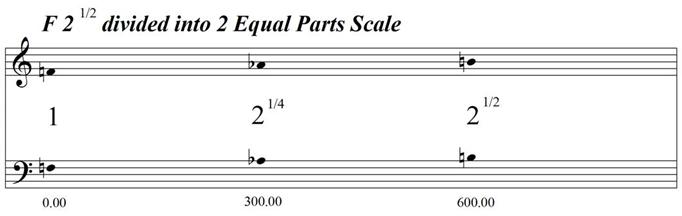
Scale of the Day: F Square-root-of-2 Divided into 2 Equal Parts

FSquareRootOf2DividedInto2EqualParts

The F Square-root-of-2 Divided into 2 Equal Parts Scale. The 600-cent "tritone" is the interval of equivalence in this simple-division scale.

-------------
This scale marks the end of a long cycle. Tomorrow's scale of the day will begin a new one with a return to subtractive scales. The next cycle will feature the first 5-limit tunning of a diatonic scale (5-limit diatonic harmony, in my opinion, is the ideal way to hear Western classical harmony). Which is one reason why this next cycle has been much anticipated here at HurdAudio.

There will also be the first audio sample of an octotonic-1 scale and the Mixolydian mapped to the Square-root-of-2 will be the quarter-tone scale rendered in audio over this next sequence. And simple division scales (like the one featured today) will begin to look at just divisions as opposed to the equal ones explored so far.