Sunday, November 04, 2007

Denmanic Polyrhythms

Denman Maroney Quintet @ An Die Musik, Baltimore, MD
Saturday, November 3, 2007

Denman Maroney: hyperpiano
Dave Ballou: trumpet
Reuben Radding: bass
Ned Rothenberg: reeds
Michael Sarin: drums

Denman Maroney's music mines a beautiful rhythmic angularity as layers of polyrhythms test the musicianship and concentration of his quintet for a sound that is both tight and deliriously off kilter. The individual parts are kept simple, yet animated, with Maroney's left hand lending a stride piano pattern of a 2-against-1 pattern that occasionally anchors the texture. Maroney's right hand was often literally "single handedly" executing cross-rhythmic patterns or lending some well-placed, spare voicings (I was particularly fond of the way he used major seconds). The individual players of the quartet animated their own independent parts so that the overall sound was far more than cyclical rhythmic patterns unfolding as temporal manifestations of whole-numbers. The extreme levels of concentration never overwhelmed the musicality of the performance as they managed to cling to a tenuously obscured pulse.

The first set consisted of shorter works - many of which Maroney has recorded with Mark Dresser - that were a pleasure to finally hear live. Pieces like "Double You" and "MC" are already in frequent rotation at HurdAudio and it was a pleasant surprise to watch how those textures are put together in performance. The second set featured a world premiere performance of Udentity - a substantial long-form composition that dives deep into Maroney's polyrhythmic sensibilities. Maroney's use of empty CD "jewel boxes" inside the piano was particularly interesting as he dragged them lengthwise along the strings at alternating intervals to create an acoustic version of a Shepard Tone. Udentity was occasionally unpolished in this performance, but intensely captivating throughout.

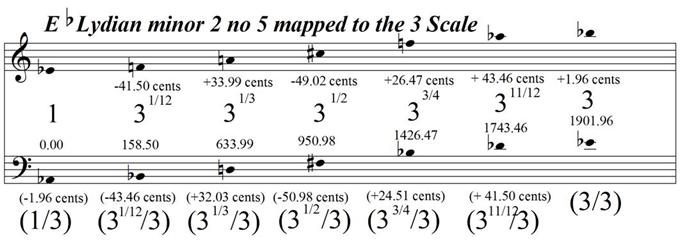
Scale of the Day: E Flat Lydian minor 2 no 5 mapped to the Triative

EFlatLydianMinor2No5MappedToTheTriative

The E Flat Lydian minor 2 no 5 mapped to the Triative Scale. The name says it all. It's an equal tempered altered/subtractive Lydian stretched out to fit the just perfect 12th of the 3/1. I realize that the diminished fourth spelling between the fourth and fifth degrees is atrocious. But this is just one of many scales where standard notation begins to deteriorate and I'd argue that proper enharmonic spellings in equal tempered systems is a moot point anyway.

Saturday, November 03, 2007

HurdAudio Rotation: The -man Edition - Feldman/Coleman

Morton Feldman: Works for Piano. 1990. Hat Hut Records: CD 6035.

Marianne Schroeder: piano

Intermission 5 (1952)
Piano Piece to Philip Guston (1963)
Vertical Thoughts 4 (1963)
Piano (1977)
Palais de mari for Francesco Clemente (1986)

These piano works consist of the barest of strokes as each gesture recedes into the stillness. The silence is barely intruded upon by the soft ripples set in motion by a deliberate quietness. Like much of Morton Feldman's music, these pieces demand a unique space that stands in sharp contrast to a noise filled world. The long, languid durations of Piano and Palais de mari exist in a rarefied open space that effortlessly draw the attentive listener toward serene meditation.

Morton Feldman: Complete Works for Two Pianists. 2002. Alice Musik Production: ALCD 024.

Mats Persson: piano
Kristine Scholz: piano

Vertical Thouhts 1 for Two Pianos (1963)
Intermission 6 for One or Two Pianos (1953)
Projection 3 for Two Pianos (1951)
Intermission 6 for One or Two Pianos (1953)
Two Pieces for Two Pianos (1954)
Piano (Three Hands) (1957)
Intermission 6 for One or Two Pianos (1953)
Piano Four Hands (1958)
Work for Two Pianists (1958)
Ixion - For Two Pianos (1958)
Inte
rmission 6 for One or Two Pianos (1953)
Two Pianos (1957)

Even the air stands still in the midst of Feldman's piano music. The presence of two pianos and/or three to four hands adds only color while the sense of size is strictly temporal. Spare gestures come and go, occasionally repeating, without the slightest nod toward formal development. This is a music of proportions and suspended states as opposed to narrative drive. It is other worldly and painfully beautiful. And it is a music that is so close in spirit and practice to the abstract paintings that Feldman admired as to distance itself from centuries of cumulated assumptions about musical practice.

Ornette Coleman: Beauty is a Rare Thing - [disc 1]. Recorded in 1959, re-released in 1993. Rhino/Atlantic Jazz: R2 71410.

Ornette Coleman: alto saxophone
Don Cherry: cornet
Charlie Haden: bass
Billy Higgins: drums

I'll just start by stating the obvious: if you have a genuine love for jazz then you already own this box set. Beauty is a Rare Thing is mandatory listening as it's hard to imagine the history of jazz from 1960 on if these sessions hadn't been recorded.

Disc one presents the chronological recordings from May 22, 1959 and part of October 8, 1959. These are the sessions that produced The Shape of Jazz to Come (both literally and in title) as well as tracks from The Art of the Improvisers, Change of the Century, Twins and To Whom Who Keeps a Record. Given the astonishing quality of this music and way it continues to affect these ears with each new listening the set list reads like poetry:

Focus On Sanity
Chronology
Peace
Congeniality
Lonely Woman
Monk And The Nun
Just For You
Eventually
Una Muy Bonita
Bird Food
Change of the Century
Music Always

Each title stirring the heart and mind with reverence and passion. Each performance filled with even more nuance and brilliance that shifts into focus with increasing clarity with every listening. It's amazing how all the different parts of this music lock into place. From the melodic contours of these enduring compositions to the free improvisations that infuse every second with human vitality to the inspired interplay between four awe-inspiring musicians, this music will continue to shape jazz to come as time shades deeper into the 21st century.

Scale of the Day: E Flat Pythagorean Lydian no 5 mapped to the Square-root-of-2

EFlatPythagoreanLydianNo5MappedToTheSquareRootOf2

The E Flat Pythagorean Lydian no 5 mapped to the Square-root-of-2 Scale. A Pythagorean refinement of the quarter-tone scale with the subtracted fifth degree allowing for 6-pitches per 600-cents (the interval of harmonic equivalence). I could have represented the frequency ratio of the square-root-of-(81/64) as the more conventional 9/8 Pythagorean whole-tone (9/8 being the square root of 81/64). But the visual representation of squaring all the standard otonal Pythagorean intervals is more appealing.

Friday, November 02, 2007

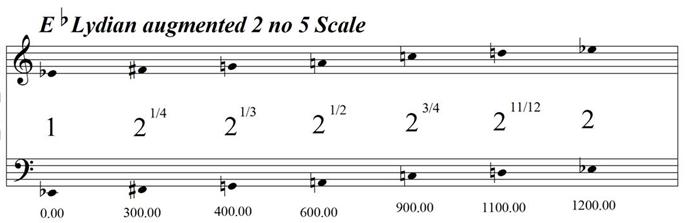
Scale of the Day: E Flat Lydian augmented 2 no 5

EFlatLydianAugmented2No5

The E Flat Lydian augmented 2 no 5 Scale as one would find it on any conventionally tuned, equal tempered instrument. This scale takes on an interesting color with the minor third between the augmented second and augmented fourth as well as between the now adjacent augmented fourth and major sixth forming a counterbalance to the similarly 300-cent sized augmented second between the tonic and second degree. The "full diminished" chord of E Flat, F Sharp, A natural and C natural adds a darkness to the normally lighter shade of the Lydian scale.

Thursday, November 01, 2007

Carving Melodic Lines Along a String Trio

Bill Frisell's Disfarmer Trio @ An Die Musik, Baltimore, MD
Wednesday, October 31, 2007

Bill Frisell: guitars, effects, loops
Greg Leisz: lap steel guitar
Jenny Scheinman: violin

Bill Frisell has a way of filling a room with sound (and packed venues). And while he was using far more effects than I'd seen him use in the past he still occupies a focal point with understatement and restraint. Not to mention his usual awe inspiring musicianship. It's takes a rare talent to make ring modulated bluegrass lines sound so introspective and natural.

Frisell's approach toward melody continues to fascinate my ears. At times the melodic line is barely a whisper within the soft haze of loops and improvised phrases that swirl in a tight orbit around the core melody. There are moments of surprising familiarity, such as "When You Wish Upon A Star" begins to float to the surface, detected by the ears just ahead of its clearest articulations. Sometimes the melody feels like the framework for the sound, at other times it is just the opposite. Either way the sound is incredible with enormous pull through its earthy tone and surprising arrangements.

Greg Leisz and Jenny Scheinman make excellent partners for the Americana sound that Frisell has been mining for some time now. The deliberate strokes and intriguing amplified sound from Scheinman carve a rich territory drawing from jazz and bluegrass traditions while Leisz is an impressive force on the lap steel guitar. (I hope Scheinman brings one of her bands back to An Die Musik sometime soon as she's been actively recording and touring with her own music recently.) The first set featured Frisell's looping textures, some blues and hints of Appalachia while the second set lurched into material from Frisell's The Intercontinentals - a recording that all three of these musicians were part of - followed by a pair of encores. The haze of sound from "Your Cheatin' Heart" seemed to linger as the large crowd shuffled from the hall. To be engulfed in this wonderful sound in such a small, comfortable venue is an experience to savor.

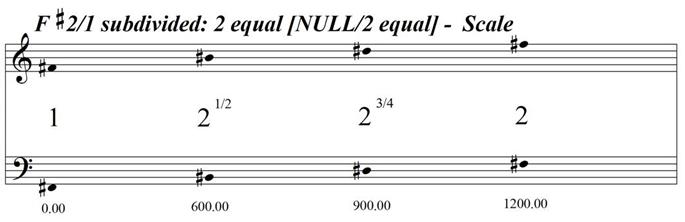
Scale of the Day: F Sharp Octave subdivided: 2 equal [NULL/2 equal]

FSharpOctaveSubdivided2EqualNULL2Equal

The F Sharp Octave subdivided: 2 equal [NULL/2 equal] Scale as one would find it on any conventionally tuned, equal tempered instrument. The scale name is the formula of its origin: divide an octave into two equal parts - resulting in a "tritone" between the octave. As this is a subtractive scale, the first tritone is not divided (hence the 'NULL' value) while the second is cut into two 300-cent minor thirds - resulting in a diminished triad leading up to the tonic. This is a particularly sparse example of a scale where all the tonal energy pulls upward toward the tonic because of the relative density of notes grouped in the later half of the octave.