Showing posts with label Sun Ra. Show all posts

Wednesday, September 14, 2011

HurdAudio Rotation: From Blasphemy to Saturn to Minnimalism

Yoshie Fruchter's Pitom: Blasphemy and Other Serious Crimes. 2011. Tzadik: 8158.

Yoshie Fruchter: guitarLinkJeremy Brown: violin, viola
Shanir Ezra Blumenkranz: bass
Kevin Zubek: drums

Chances are you won't realize how starved your ears are for klezmer metal before putting on a dose of Blasphemy and Other Serious Crimes. An alliance that is truly unholy. A hybrid that plies equal respect to the metal and the klezmer without sacrificing the irreverence that animates this set. There's nothing flashy or kitsch about Pitom's approach to this music as they ply more than enough musical chops to pull this material off. Soaring violin solos over a driving beat never sounded more natural. The only question is where does one turn once Blasphemy and Other Serious Crimes exposes one's addiction to this klez-core? The ears eagerly await more from this band as they develop this rich sound.

Ephraim Asili: Points On A Space Age - Starring The Sun Ra Arkestra. [DVD] 2009. MVD Visual: MDVV4774.

A glimpse into an optimistic tomorrow that continues to reverberate even as the future rushes forward with indifference. Cut together with NASA footage, the Marshall Allen incarnation of the Arkestra as it exists in this day, President John F. Kennedy's soaring speech about the dawning space age, the poetry of Sun Ra as read by Ephriaim Asili and interviews with members of the present day Arkestra. The physical absence of Sun Ra sets the tone for this short presentation. The love of his music and vision by those who carry forward with the realization that he (and they) may never receive their due before their final chapter is written. The devotion is other worldly. The gentle persistence of this art should be enough in a perfect world. But this world was never enough for those who know the ways of Saturn. Just as the Presidential vision of space travel "to the ends of this solar system and beyond" recedes into a more distant place. This is a music that calls for an idealism that breaks our own petty borders and terrestrial concerns.

Steve Reich: Music for 18 Musicians. 2007. Innova: 678.

Grand Valley State University New Music Ensemble
Bill Ryan: director
Gwendolyn Faasen, Stacey Van Vossen, Mary Crossman: voices
Amanda Duncan: voice, marimba
Alexander Hamel: xylophone, marimba, maracas
Samuel Gould: xylophone
Nicholas Usadel, Tim Church: marimbas
Joshua Puranen: marimba, maracas
Gregrey Secor: vibraphone
Daniel Redner: pian, maracas
Craig Avery: piano, marimba
Shaun MacDonald, Kelly Rizzo, Kurt Ellenberger, Lee Copenhaver: piano
Mark Martin: violin
Pablo Mahave-Veglia: cello
Charlen Meuller, Alexander Kolias: clarinet, bass clarinet

Music for 18 Musicians has become a canonical work in that aficionados now have multiple recordings of different performances to obsess about in the same way Mahler fans can pick apart and debate the various recordings of his symphonic works. Sonically it makes sense that Music for 18 Musicians would soar toward a such a status with the way it singularly defined and propelled much of Steve Reich's instrumental music writing that followed. One would be hard pressed to do better than the spirited and faithful rendering from the Grand Valley State University as it is beautifully recorded on this release. It's an ensemble work that weaves together an attractive tapestry from individual threads that rarely puncture the foreground as individual players. Over the past year I have heard this piece performed live twice and anticipate a bright future with stages full of pianos and marimbas as further generations of performers discover this amazing work.

Saturday, August 20, 2011

HurdAudio Rotation: Connecting Tissues

Curlew: 1st Album + Live at CBGB 1980. 2008. Downtown Music Gallery: DMG/ARC-0704.

George Cartwright: alto saxophone, tenor saxophone, soprano saxophone
Tom Cora: cello, indingiti
Nicky Skopelitis: guitar
Bill Laswell: fender bass
Bill Bacon: drums, percussion, gamelan
Denardo Coleman: drum kit

This double-CD re-issue from the Downtown Music Gallery is an incredibly valuable documentation of one of the key ensembles of the "downtown" New York scene of the early eighties. At a time when so many New York based ensembles were only timidly blurring musical boundaries, Curlew was forming a sound that aggressively confounded stylistic conventions. One of the few bands that could haunt CBGB's punk venue and the old Knitting Factory stage on Houston Street without altering their set. The surprising thing about this 1st Album is how fully formed the Curlew sound was right from this early incarnation of the band. The Bill Laswell and Nicky Skopelitis connection are a surprise to me. Though I can hear how Laswell's electric bass sound and influence would continue to reverberate with the band in the years and bassists that followed. Skopelitis clearly paves the way for the Davey Williams guitar freak outs a few years down the road. The Denardo Coleman connection on the Live at CBGB 1980 set is another surprise and another name to add to the list of jazz drummers who passed through Curlew. The melodic materials bear George Cartwright's stamp and would prove to be an enduring part of the Curlew DNA. Also, any chance to fill these ears with the late Tom Cora's cello playing is a welcome part of my collection. The electric bass sits a little too far into the foreground on the live sets. But that's a small imperfection on an otherwise outstanding documentation of this significant downtown staple.Link
Sun Ra: Strange Celestial Road. 1987. Rounder Records: CD 3035.

Sun Ra: keyboards
Michael Ray, Curt Pulliam, Walter Miller: trumpets
Craig Harris, Tony Bethel: trombones
Harry Wilson, Damon Choice: vibes
Richard Williams, Steve Clarke: bass
Vincent Chancey: french horn
John Gilmore, Marshall Allen, Elo Omoe, James Jacson, Danny Thompson, Kenny Williams, Hutch Jones, Sylvester Baton, Noel Scott: reeds
Luqman Ali, Reg McDonald: drums
Artaukatune: percussion
Skeeter McFarland, Taylor Richardson: guitars
June Tyson, Rhoda Blount: vocals

Evidence that the celestial being of Sun Ra was subjected to the gravitational forces and the energies of given time periods as the Arkestra emerged from the decade of the 1970s with something funky in their sound. And yet this is still the Arkestra as Sun Ra paints his sonic canvas with considerable skill with an ear toward the cosmos. Utilizing the size of the ensemble to constantly pull different instruments into and out of the focal point within a bed of luscious, funky sound. Sun Ra traveled a long road, he traveled the space ways and every vibration does reverberate with a heady mix that never loses its physical attachment to rhythm and melody. The groove cuts especially deep on this one as the familiar phrases and chants wash over and beyond. A fascinating, albeit brief glimpse into a specific moment of the Arkestra's evolution.
Link
David Lang: Child. 2003. Cantaloupe Music: CA21013.

Child for chamber ensemble
Sentieri Selvaggi
Carlo Boccadoro: conductor
Paola Fre: flute, piccolo
Mirco Ghirardini: clarinet, bass clarinet
Andrea Rebaudengo: piano
Thomas Schrott: violin, brake drum
Antonello Leofreddi: viola
Marco Decimo: cello, brake drum
Andrea Dulbecco: vibraphone, percussion
Filippo Del Corno: brake drum

A minimalist meditation upon the biological formation of the human child in utero. At times delicate, and composed with a sweetness that suggests innocence. David Lang manages to tread just within the bounds of a sugarless sweetness. One without a sticky residue that wears thin with prolonged exposure. Sentieri Selvaggi gives this music a uniquely disciplined and human interpretation that flows with the gentle insistence of a babbling brook. Much of the counter-sweetness draws upon the compositional courage to allow repeated systems to remain static and untouched by Romantic inclinations. This is tender and beautiful music.

Sunday, January 30, 2011

HurdAudio Rotation: Three Ways to Get Your Freak On

Doctor Nerve with the Sirius String Quartet: Ereia. 2000. Cuneiform Records: rune 126.

Nick Didkovsky: electric guitar, composition
Greg Anderson: bass
Leo Ciesa: drums
Yves Duboin: soprano saxophone, flute
Rob Henke: trumpet
Michael Lytle: bass clarinet
Kathleen Supove: keyboards
Joyce Hammann: violin
Mary Whitaker: violin
Ron Lawrence: viola
Tomas Ulrich: cello
Todd Reynolds: violin
Liz Knowles: violin
Mary Wooten: cello

Ereia is a direct manifestation of the multiple impulses that inform Nick Didkovsky's creative influences. The relentlessly progressive guitar rocker with a slant toward cerebral avant art music finds himself with a band, a string quartet and a commission at his disposal. Conceived as a 3-movement work, Ereia is scored for string quartet alone in the first movement, a conducted improvisation and the third movement as a culmination of the two forces as a composed work for full ensemble. The decision to sandwich the conducted improvisation as a live recording between two studio realizations further adds to the contrast between these three parts. Though there are plenty of similarities to thread the entire work together and challenge multiple assumptions about the artificial lines that divide genre, medium and aesthetic. Ereia sustains an aggressive luminosity throughout while also revealing several moments of human frailty. Beauty and ugly co-mingling within a sonic stew.

Sun Ra: Disco 3000: Complete Milan Concert 1978. (Re-released in 2009) Art Yard: CD 001.

Sun Ra: piano, organ , moog synth, rhythm machine, vocals
John Gilmore: tenor saxophone, drums, vocals
Luqman Ali: drums, vocals
Michael Ray: trumpet, vocals
June Tyson: vocals

Space is definitely the place. A place rich with the blues, dancing aliens, friendly galaxies, somewhere over the rainbows and some far-out analog synth freak outs. Sun Ra's singularity finds particular resonance in this 2+ hour live set from 1978. Clearly an important document of the Sun Ra sound from that era. The stripped down group drawn from members of the Arkestra gives the ears a chance focus on a mature John Gilmore and the explosive energy of Michael Ray.

The Peter Brötzmann Octet: The Complete Machine Gun Sessions. 2007 re-issue of the 1968 sessions. FMP/Atavistic: Archive Edition ALP 262 CD.

Peter Brötzmann: tenor saxophone, baritone saxophone
Even Johansson: drums
Peter Kowald: bass
Willem Breuker: tenor saxophone
Fred Van Hove: piano
Evan Parker: tenor saxophone
Buschi Niebergall: bass
Han Bennink: drums

Eight improvising musicians assembled in Bremen's Lile Eule in May of 1968 and subsequently changed the world with a blistering performance that still leaves cochlear scars to this day. The backdrop of political assassinations, an increasingly unpopular war in Vietnam, the disastrous convention in Chicago and an environment of protests across North America and Europe serves as the spiritual and psychological backdrop for the barely channeled energy of Machine Gun. It's an energy that glows with a different quality. Aggressive and focused, it is clear to these ears why this recording continues to be so important to the local improvised music scene here in Chicago. Harsh and completely necessary. This is a music that could, and has, diverted rivers in the development of free jazz archetypes.

Sunday, December 19, 2010

HurdAudio Rotation: The Persistence of Dissonance

Dave Douglas with Jim McNeely & Frankfurt Radio Bigband: A Single Sky. 2009. Greenleaf: Gre-1011.

Dave Douglas: trumpet
Frankfurt Radio Bigband
Jim McNeely: conductor
Oliver Leicht: alto saxophone, soprano saxophone, flute, alto flute, clarinet
Stefan Pfeifer-Galilea: alto saxophone, soprano saxophone, flute, clarinet
Rony Lakatos: tenor saxophone, flute
Steffen Weber: tenor saxophone, flute, clarinet
Rainer Heute: baritone saxophone, bass clarinet
Chad Shoopman: trumpet
Thomas Vogel: trumpet
Martin Auer: trumpet, flugel horn
Axel Schlosser: trumpet
Gunter Bollmann: trombone
Peter Feil: trombone
Christian Jakasjo: trombone
Manfred Honetschlager: bass trombone
Martine Scales: guitar
Peter Reiter: piano
Thomas Heidepriem: bass
Jean Paul Hochstadter: drums

"The Persistence of Memory" is an iconic Dave Douglas tune originally recorded on In Our Lifetime in 1995. The bass line, the languid melodic groove and its great harmonies left me wondering why it isn't covered by jazz players all over the world. The arrangement by Jim McNeely caught me by surprise and immediately transported me to that same awe I felt when I first discovered that tune. The Frankfurt Radio Bigband perform "The Persistence of Memory" with more than enough verve to help vaunt that tune toward a world without sufficient bandwidth to properly celebrate such excellence.

A Single Sky is a Dave Douglas record with a split identity. There is the glimpse of three movements from Douglas' own Delighted States suite. Leaving the ears hungry to experience the complete work along with the insight into Dave Douglas' arranging techniques. Then there are the Jim McNeely arrangements of Dave Douglas tunes that show off this incredible big band. Not to mention McNeely's exquisite arranging instincts. These also hint at something much larger than can be contained on this single disc. I hope there are more collaborations like this. Because this is already one of the great Douglas recordings. Highly recommended.

The Sun Ra All Stars Band: Hiroshima. 2007. Art Yard: LP 2007.

Sun Ra: piano, pipe organ
John Gilmore: tenor saxophone
Marshall Allen: alto saxophone
Archie Shepp: tenor saxophone, soprano saxophone
Don Cherry: pocket trumpet
Lester Bowie: trumpet
Philly Joe Jones: drums
Richard Davis: bass
Don Moye: drums, percussion
Clifford Jarvis: drums

The 'A' side of this LP deserves to be played at a healthy volume as Sun Ra's psychedelic pipe organ solo transmits its stern messages from outer space to all living creatures of Earth. It is a performance that draws upon the devastating shock waves of an atomic device. The fade at the end suggesting that this music could (and probably did) go on for an eternity. The 'B' side offers up some free association improvisation between a collection of giants. Hearing it is like chancing upon a conversation between artists still realizing their collective voice. Raw, unpolished and utterly beautiful.

Dane Rudhyar: Works for Piano. 2004. Hat Hut Records: hat[now]ART 140.

Steffen Schleiermacher: piano

Granites (1929)
Three Paeans (1927)
Tetragrams 1st Serie (1920-27)
Third Pentagram (1926)

Steffen Schleiermacher understands the fortissimo that this music calls for. The bombastic lyricism delivered like a fist to a wall of granite. The draw of Dane Rudhyar's piano works is that so much tenderness and mysticism can lurk within such passages of density and exquisite dissonance. Melodies surviving (and even thriving) within these pounding, modern textures. Recordings such as this allow me to subsist and scratch that Rudhyar itch until the inevitable Dane Rudhyar revival festivals begin. An important and under appreciated voice from the American compositional tapestry.

Sunday, May 30, 2010

HurdAudio Rotation: Knocking on the Door of the Cosmos

Marty Ehrlich & Myra Melford: Spark! 2007. Palmetto Records: PM 2129.

Marty Ehrlich: alto saxophone, clarinet
Myra Melford: piano

"For Leroy" is one of the more heartfelt tributes, sonic prayers and expression of joy expressed in the passing of Leroy Jenkins that I've heard. A musical offering from two musicians who had the experience of knowing and playing with the great improvising violinist. That same reverence comes around as Erhlich and Melford interpret "Images of Time," composed by the late Andrew Hill. It is this impressive outward expressiveness balanced against the inward dialogue between these musicians that makes Spark! such a rewarding listen. My familiarity and appreciation for Melford's compositions runs a notch deeper with these versions of "Night," "A Generation Comes and Another Goes" and the fantastic "I See A Horizon." The Marty Ehrlich compositions call for a similar appreciation and familiarity with his work. The soul of blues and gospel music surges within this music - sometimes only barely perceptible beneath its surface. And the ability to draw upon a small number of elements that build toward a larger resonance gives this disc a sound much larger than a duo recital. This is living, vibrant music paired down to these two forces and it is very good.

Killick: Smudgeriffic. 2007. Sul Ponticello: 021 - limited run CD-R (#9 of 33).

Killick: guitar

Killick embraces the practice of free improvisation with an all consuming abandon. Every component of sound that the electric guitar can produce is fair game in this single movement study of solitary exploration. Simply plugging the instrument into the amplifier becomes a subject for rhythmic exploration. And each idea becomes subject to interruption from the next idea. In many ways, the "smudges" of Smudgeriffic is the restless movement from one timbral space to the next. Much of which reinforces my enthusiasm for the sound worlds and sensibilities this artist brings to life.

Sun Ra and his Intergalactic Myth Science Solar Arkestra: Sleeping Beauty. 1979 (re-issued in 2005). Art Yard: CD 003 & LP 003.

Sun Ra: piano, electric piano, organ, vocals
Marshall Allen: alto saxophone, flute
John Gilmore: tenor saxophone, percussion, vocals
Eloe Omoe: bass clarinet, flute, percussion
Michael Ray: trumpet, vocals
Danny Thompson: baritone saxophone, flute, percussion
Luqman Ali: drums, vocals
Noel Scott: alto saxophone, baritone saxophone, percussion
Craig Harris: trombone
Tony Bethel: trombone
Vincent Chancey: french horn
James Jackson: bassoon, flute, percussion
Walter Miller: trumpet
June Tyson: vocals
Rhoda Blount: vocals
Richard Williams: electric bass
Stanley Morgan: congas
Harry Wilson: vibraphone
Curt Pulliam: trumpet
Kenny Williams: tenor saxophone, flute
Hutch Jones: alto saxophone, tenor saxophone
Taylor Richardson: electric guitar
Steve Clark: electric bass
Damon Choice: vibraphone, vocals
Eddie Thomas: drums
Reg McDonald: drums
Atakatune: percussion
Sylvester Baton: reeds

A surprisingly laid back and deep groove pathway through the cosmos. Thick with keyboards and an Arkestra of astonishing talent. The John Gilmore solos send chills down the spine with their explosive energy. The "space jazz" message feels disguised by the soulfulness of this session. But it is ever present in the chants that wind through this material. Proving that Sun Ra's interstellar vision didn't exist in a vacuum as it adapted to the twists and bends of genre while still running light years ahead of its time. Put this one on the turntable on a hot day with the windows open.

Monday, November 02, 2009

HurdAudio Rotation: Exiles and Lizards

Chris McGregor's Brotherhood of Breath: Travelling Somewhere. 1973 (re-issued in 2001). Cuneiform: Rune 152.

Chris McGregor: piano
Harry Beckett: trumpet
Mark Charig: trumpet
Nick Evans: trombone
Mongezi Feza: trumpet
Malcolm Griffiths: trombone
Harry Miller: double bass
Louis Moholo: drums
Mike Osborne: alto saxophone
Evan Parker: tenor saxophone
Dudu Pukwana: alto saxophone
Gary Windo: tenor saxophone

The Brotherhood of Breath is so under-documented that every scrapbook of joyful sound is incredibly valuable. Improvisation of the highest order built upon layers of human experience, cultural reference points and exile. The unusual challenges endured by this mix of South African and European musicians pouring out with a vibration of fervent humanity. Here lie multiple avenues for large ensemble writing yet to be fully explored.

The Lounge Lizards: Queen of All Ears. 1998. Strange & Beautiful Music: SB 0015.

John Lurie: alto saxophone, soprano saxophone, vocals
Michael Blake: tenor saxophone, bass clarinet
Steven Bernstein: trumpet
David Tronzo: slide guitar
Evan Lurie: piano, organ
Jane Scarpantoni: cello
Erik Sanko: bass
Ben Perowsky: percussion
Calvin Weston: drums

It's good to be reminded just how much I dig this ensemble. The layering of patterns in "The First and Royal Queen" always brings a smile at the onset of this disc and the journey continues from there. Rich with musical ideas and moments of whimsy. Particularly the mad screaming set up by the story telling in "Yak." Plenty of impressive talent in this large band.

Sun Ra: The Creator of the Universe. 1971 performances (released in 2009). Transparency: 0301.

The Lost Reel Collection:
disc 1: Warehouse, San Francisco, June 10, 1971
Sun Ra with Arkestra
disc 2: 3rd Class, UC Berkeley, May 4, 1971
Sun Ra lecture

Billed as "a Sun Ra album like no other," this release of recovered reel to reel recordings from Sun Ra's time in the Bay Area does pry open the persona of Le Sony'r Ra to reveal the street preacher of his Chicago days expounding upon his concepts of racial inequality against his cosmic orientation. Disc one offering a long declamation over arkestral accompaniment while the course lecture on the second disc (from his year in residence at UC Berkeley) is accompanied by the sound of nervous laughter and chalk on blackboard. The wordplay and ability to turn concepts upside down paired with his oddly charismatic voice of prophecy. The sense of a body of music born out of relentless questioning and a willingness to dismiss accepted conventions in all matters. A documentation of thought more so than music. Beautiful, frustrating, engaging and troubling all at the same time.

Sunday, July 12, 2009

HurdAudio Rotation: Sounds from Philadelphia, Lebanon and Saturn

Katt Hernandez/Evan Lipson: Hisswig. 2007. Limited-run mini-disc.

Katt Hernandez: violin
Evan Lipson: bass

A quick hit of the Philadelphia free improvised music scene as two of its most active players lock strings and sonic agility that alternates between aggressive and delicate. The wide, slowly oscillating vibrato of Hernandez's violin drifting within Lipson's orbit before launching toward slight melodic turns toward new vibrato centers. Lipson's fortissimo pizzicato drawing from the foundations of jazz traditions and uncompromising in-the-moment responsiveness.

Mazen Kerbaj: Brt Vrt Zrt Krt. 2005. Al Maslakh: 01.

Mazen Kerbaj: trumpet

There's two sides to this solo trumpet music. There's the "how the hell is he making that sound" side. And once one puzzles out the extremes of coaxing out such extended acoustic source the mind turns toward "how the hell do you record that sound." The virtuosity here is in the maniacal realization of a concrete soundscape without recourse to electronic manipulation. It's profoundly beautiful and fiercely like anything else. It draws the ears well into the inner plumbing of the instrument through the humanity of breath and mind. The geopolitical backdrop of this musician, record producer and cartoonist from Lebanon's somewhat isolated free improvised music scene adds a fascinating dimension that plays pathos against the fiercely independent qualities of this music.

The Sun Ra Arkestra under the direction of Marshall Allen: Points On A Space Age. DVD. Directed by Ephraim Asili. 2009. MVD Visual: MVDV4774.

When does Marshall Allen get his just due? A question forcefully posed by one of the surviving Arkestra members in this video as the final Marshall Allen chapter of the music and wisdom of Sun Ra is being written. "What will happen to the kids that really want to know this music? This guy is in his 80s! Where will they go to learn when all we are left with is mediocrity?" The practitioners of this music serve a dual role as disciples sent out by an absent Ra to prepare human beings for a future that almost defies comprehension within a society dominated by consumer-driven sensibilities. When reduced to spectacle and packaged entertainment along with an inability to discuss music in terms other than units sold (and downloaded) it becomes harder to impart the vision of a band leader who took such creative control over his own narrative. The man from Saturn preparing our souls for journeys that transcend.

Points On A Space Age documents a frustratingly brief slice of the Marshall Allen chapter. It's hard to imagine how a video of any duration could capture the nearly indescribable experience of a live Arkestra show. With just over half an hour this video doesn't attempt to bring that, though there are glimpses of performance footage - including a powerful segment of dance set to "Love in Outer Space" - that is rarely allowed to develop and unfold at its own pace as performances are spliced and manhandled by the editing process. There is also a small sampling of interviews with individual performers that brings out a taste of the mixture of belief and passion in the practice of this music. Segmented by Ra's poetry as read by director Ephraim Asil, there is no shortage of love in this video. But it is short considering the magnitude of the subject. A small document that scatters along multiple trajectories of sound, archival footage and interviews that hints at something much larger.

Friday, July 03, 2009

HurdAudio Rotation: The Strange Celestial Road to Endless Heaven

Curlew: 1st Album + Live at CBGB 1980. 1981, 1984, 2008. Landslide Records: DMG/ARC-0704.

George Cartwright: alto saxophone, tenor saxophone, soprano saxophone
Tom Cora: cello, indingiti
Nicky Skopelitis: guitar
Bill Laswell: fender bass
Bill Bacon: drums, percussion, gamelan
-
George Cartwright: alto saxophone, tenor saxophone, soprano saxophone
Tom Cora: cello, indingiti
Nicky Skopelitis: guitar
Bill Laswell: fender bass
Denardo Coleman: drum kit

It's hard to stop smiling when hearing all these early Curlew creations. I was fortunate to catch this band live a couple of times in a slightly later incarnation, one that included the riveting Tom Cora on cello. This music grooves along with plenty of odd contours and free improvisation sitting in the pockets formed along the seams of these arrangements. One can practically hear the birth of the "downtown" movement as it forcefully careened over to where the gentrified and packaged world of "fusion" utterly failed. A lot of great music followed in the wake of Curlew, but these early pieces have an ageless charm.

Sun Ra: Strange Celestial Road. 1987. Rounder Records: CD 3035.

Sun Ra: keyboards
Michael Ray, Curt Pulliam, Walter Miller: trumpet
Craig Harris, Tony Bethel: trombone
Harry Wilson, Damon Choice: vibraphone
Richard Williams, Steve Clarke: bass
Vincent Chancey: french horn
John Gilmore, Marshall Allen, Elo Omoe, James Jacson, Danny Thompson, Kenny Williams, Hutch Jones, Sylvester Baton, Noel Scott: reeds
Luqman Ali, Reg McDonald: drums
Artaukatune: percussion
Skeeter McFarland, Taylor Richardson: guitar
June Tyson, Rhoda Blount: vocals

"Traveling. Strange celestial road. A strange celestial road. To endless heaven." The road is not so hard. Buoyed by the sonic signposts thoughtfully placed by Sun Ra as he made the advance journey ahead of us all. Here we have a document of a time when these musicians assembled and played with feeling before so many of them were to embark upon their own journey down that road. Hinting only at the length and transcendence of that road through a brief burst of joyous sound. One suspects that the road itself continues long after the double bar lines at the end of the score.

David Lang: Child. 2003. Cantaloupe Music: CA21013.

performed by Sentieri Selvaggi
Carlo Boccadoro: conductor, piano, brake drum
Paola Fre: flute, piccolo
Mirco Ghirardini: clarinet, bass clarinet
Andrea Rebaudengo: piano
Thomas Schrott: violin, brake drum
Antonello Leofreddi: viola
Marco Decimo: cello, brake drum
Andrea Dulbecco: vibraphone, percussion
Filippo Del Corno: brake drum

A work of minimalist simplicity that drifts along in wisps like the breeze from my open window. The steady growth, and formation of motif-based ideas building upon layers as understated sonic expression of biological growth that unfolds with equal softness all around us.

Friday, November 28, 2008

HurdAudio Rotation: Spaceways Incorporated

Peter Apfelbaum & The Hieroglyphics Ensemble: Jodoji Brightness. 1992. Polygram Records/Antilles: 314-512 320-2.

Peter Apfelbaum: tenor saxophone, piano, organ, synthesizer, drums, percussion
Bill Ortiz: trumpet, flugelhorn
Jeff Cressman: trombone, pyramid bell, percussion
James Harvey: trombone
Paul Hanson: alto saxophone, tenor saxophone, bassoon
Tony Jones: tenor saxophone
Peck Allmond: soprano saxophone, tenor saxophone, baritone saxophone, trumpet
Norbert Stachel: soprano saxophone, alto saxophone, tenor saxophone, baritone saxophone, bass saxophone, clarinet, flute, piccolo
Will Bernard: guitar
Stan Franks: guitar
Jai Uttal: guitar, harmonium, dotar, percussion
Bo Freeman: bass
Joshua Jones V: drums, timbales, bass drum, congas, bata, vocals
Deszon X. Claiborne: drums, percussion
"Buddha" Robert Huffman: congas, bell tree, gongs, bata, vocals
Rachel Durling: violin
Steven Bernstein: trumpet
Sekou Heath: bata, percussion, vocals

A dear friend, and frequent companion in the rotation, to these ears. Wonderful ensemble writing. A pan-stylistic approach to jazz that folds in a world of materials with respect for the history and humanity running throughout its various roots. Never a phrase or nod that feels anything less than deeply felt and human. One of the great recordings due some kind of revival.

Sun Ra: Disco 3000: Complete Milan Concert 1978. 2007. Art Yard Records: CD 001.

Sun Ra: piano, organ, moog synthesizer, rhythm machine, vocals
John Gilmore: tenor saxophone, drums, vocals
Luqman Ali: drums, vocals
Michael Ray: trumpet, vocals
June Tyson: vocals

How did this dimension contain the force of Sun Ra for as long as it did? Sun Ra with a great band working the outer limits (and a bit beyond) over a prolonged live show in Milan. At the core of the analog technology, the free blowing freak outs and sonic excursions well into the ether is a solid sense of the tunes (or even the blues). Space is a friendly place and Ra owns a big piece of it on this session. Many kudos to the folks at Art Yard for getting this double-CD out where more earth folks can experience it.

The Peter Brötzmann Octet: The Complete Machine Gun Sessions. 1968. Re-released in 2007. Atavistic/FMP: ALP262CD.

Peter Brötzmann: tenor saxophone, baritone saxophone
Sven-Ake Johansson: drums
Peter Kowald: Bass
Willem Breuker: tenor saxophone
Fred Van Hove: piano
Evan Parker: tenor saxophone
Buschi Niebergall: bass
Han Bennink: drums

The legendary European free jazz bombshell is still lethal. The relentless onslaught would send most running for cover long before one gets past the original LP material in this "complete" collection. A much needed reminder that jazz - and all musics - is entirely capable of working the relaxation-hostile end of the spectrum. Smoothing the rough edges of Machine Gun out would leave nothing in its wake. And it's a necessary and memorable experience for it. But then, they don't call it "pop gun" and these players aren't firing blanks.

Sunday, November 23, 2008

HurdAudio Rotation: Works for/with Piano and A Good Church Organ Freak Out

NOW Orchestra & Marilyn Crispell: Pola. 2005. Victo: cd 097.

Marilyn Crispell: piano
Kate Hammett-Vaughan: voice
Bruce Freedman: alto saxophone
Graham Ord: tenor saxophone, soprano saxophone, flute
Saul Berson: alto saxophone, clarinet, flute
John Korsrud: trumpet, bugle
Kevin Elaschuk: trumpet, bugle
Rod Murray: trombone
Brad Muirhead: bass trombone
Ron Samworth: guitar
Paul Blaney: bass
Clyde Reed: bass
Dylan van der Schyff: drums
Coat Cooke: baritone saxoophone, tenor saxophone, flute, artistic director

Vancouver group improvisation meets Marilyn Crispell of Woodstock, NY. And the results are every bit as intoxicating as the combination of these elements would suggest. This has the feel of a NOW comprovisation with generous splashes of Crispell's pianistic sound. Though Paul Plimley - NOW's regular pianist - is also a favorite of mine and the chance to mix those two contrasting forces on the ivories feels like a missed opportunity. Not that any part of this recording is empty or lacking. The ensemble shifts generously between large and small subgroups with plenty of free swinging from every angle.

The Sun Ra All Stars Band - Stars That Shine Darkly: Hiroshima. Recorded in 1983. Released on LP in 2007. Art Yard: LP 2007.

Sun Ra: piano, pipe organ
John Gilmore: tenor saxophone
Marshall Allen: alto saxophone
Archie Shepp: tenor saxophone, soprano saxophone
Don Cherry: pocket trumpet
Lester Bowie: trumpet
Philly Joe Jones: drums
Richard Davis: bass
Don Moye: drums, percussion
Clifford Jarvis: drums

That's a serious list of "all stars" to contend with. And that's just the crew on the "B-side" of this vinyl wonder. "Hiroshima" is Sun Ra painting in deeply explosive hues on the church organ with some light percussion accompaniment. It's a performance that treads into extremes of expressive Ra and heat with all the expansive duration of a single side. And it leaves a mark. Then there's the formidable cast on the flip side playing "Stars that Shine Darkly." Different Ra canvas featuring a medium of collaborative creation pointed toward the same severity of Ra-ism. Heavy, luminous and every bit the real, surreal and undiluted deal. This is a tough entry point for those unfamiliar with the Saturnian great one. But an excellent document for those already riding the Spaceways.

Dane Rudhyar: Works for Piano. 2004. Hat Hut: hat[now]ART 140.

Steffen Schleiermacher: piano

Jagged, dissonantly beautiful solo works for piano from the underrated composer and astrologist. Steffen Schleiermacher plumbs the range between quiet and blisteringly loud in these demanding works that leaves the ears ringing with this resonant force. The harmonic language is that remarkable, early twentieth century American sensibility that feels out dissonance through intuition over system. The titles bear the images of star signs and pentagrams that suggest an overtly mystical side to this music. Rudhyar is a long standing fascination for these ears.

Thursday, May 29, 2008

Around the Blogs: Afro-Futurism and the State of Race in Creative Improvised Music

By way of the Chapel Performance Space blog comes word of a Sun Ra Tribute Band led by an Earthly cast of Seattle area players - Stuart Dempster: trombone, Bill Smith: clarinet, Tom Baker: guitar, Greg Sinibaldi: saxophone, Michael Monhart: saxophone, Jim Knodle: trumpet, Lynette Westendorf: piano, Greg Campbell: percussion, horn, Dan O'Brien: bass, Bill Moyer: percussion. Expect to see more bands like this as the beauty of Sun Ra's music continues to build increasing resonance in this dimension.

While a love of Sun Ra is transcendent, the contrast between the image of the tribute band and the current Arkestra is striking. Against the backdrop of an electrifying Barack Obama presidential campaign with all of its progressive promise of positive change and the thoughtful discussion of race in jazz sparked around the blogs by Ethan Iverson's incredible essays over at Do the Math on difficult questions about Lennie Tristano, Lee Konitz and Warne Marsh. Read the whole series of essays. Tristano's claim as an early pioneer of free improvised music has long been a curiosity for me. Approaching his music as belonging to the tradition of Conlon Nancarrow and Charles Ives - as Iverson concludes to be more appropriate - does place his music in a profoundly different context. Stanley Crouch's assertion that Tristano's turn toward European traditions (at the expense of the African diaspora) did little to advance jazz reinforces this uncomfortable segregation of Tristano into the "American Maverick" tradition. As one who loves the musical traditions of Charles Ives and Thelonious Monk with equal affection this conversation raises multiple points about how the complex history of immigrants and emancipated slaves is reflected in the development of the arts. And in particular how the injustices and biases carry over into how each tradition develops relative to one another. Sun Ra - whose role as an early pioneer of free improvised music is more compelling than Tristano's - may have completely embraced the persona of a being from Saturn in part as a reaction to the ugliness of racism in the America in his day. His music is compelling to the point that I'm inclined to believe he really was from outer space.

Soundslope writes about the Xenogenesis Suite by Nicole Mitchell. Written as a tribute to the writer Octavia Butler, who was another voice of the Afro-futurism associated with Sun Ra. I have this disc on my shelf already and it's cued up to enter the HurdAudio Rotation.

And bouncing back to the "Maverick" tradition, Alex Ross draws my attention to the music of Johanna Magdalena Beyer. An early twentieth century composer I should have learned about (and already be obsessed with) long ago. Anyone from that era associated with Charles Seeger and his "dissonant counterpoint" is someone these ears are hungry to hear. I imagine this New World double-CD and this New Albion disc are a good place to start.

Monday, May 26, 2008

Two Nights of Marshall Allen

Thee Maximalists @ Orion Sound Studios, Baltimore, MD
Saturday, May 24, 2008

Paul Sears: drums
Keith Macksoud: bass
Dave Newhouse: keyboards, saxophones, flutes, bass clarinet
Marshall Allen: alto saxophone, flute, electric valve instrument
Elliott Levin: saxophones, flute, poetry

-----

The Sun Ra Arkestra under the direction of Marshall Allen @ Sullivan Hall, New York City, New York
Sunday, May 25, 2008

Marshall Allen: alto saxophone, flute, evi
Charles Davis: tenor saxophone, percussion
Art Jenkins: percussion, vocals
Tyrone Hill: trombone
Michael Ray: trumpet, vocals
John Ore: bass
Fred Adams: trumpet
Knoel Scott: alto saxophone, percussion
Vincent Chancey: french horn
Cecil Brooks: trumpet
Danny Ray Thompson: baritone saxophone, flute
Rey Scott: trombone
Dave Davis: trombone, tuba
Luqman Ali: drums
Elson Dos Santos Nascimento: percussion
D. Hotep: guitar
Yahya Abdul-Majid: tenor saxophone, percussion
Bill Davis: bass
Farid Abdul-Bari Barron: keyboard
Wayne Anthony Smith Jr.: drums

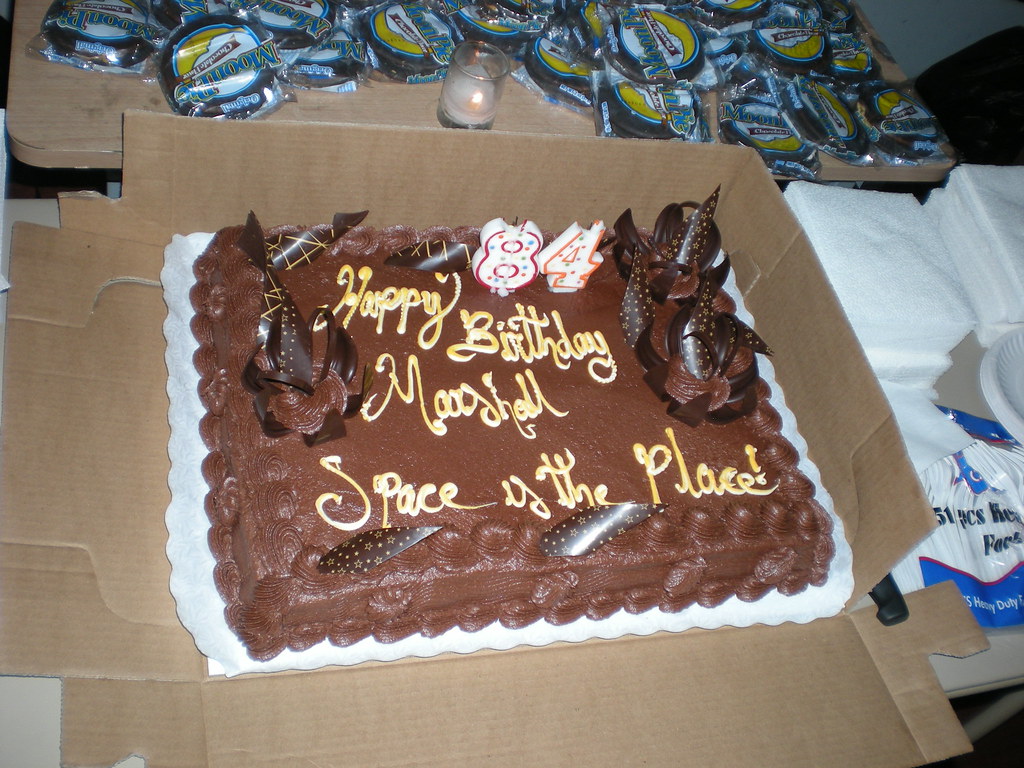
A celebration of the 84th anniversary of Marshall Allen's arrival on Earth.

------

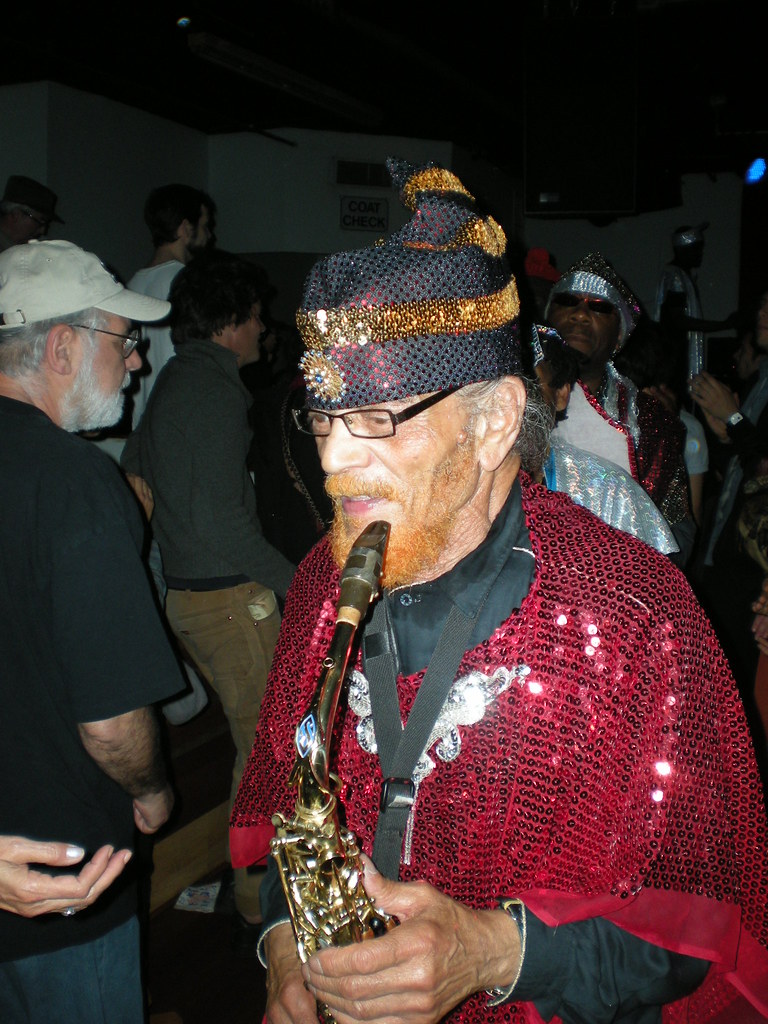
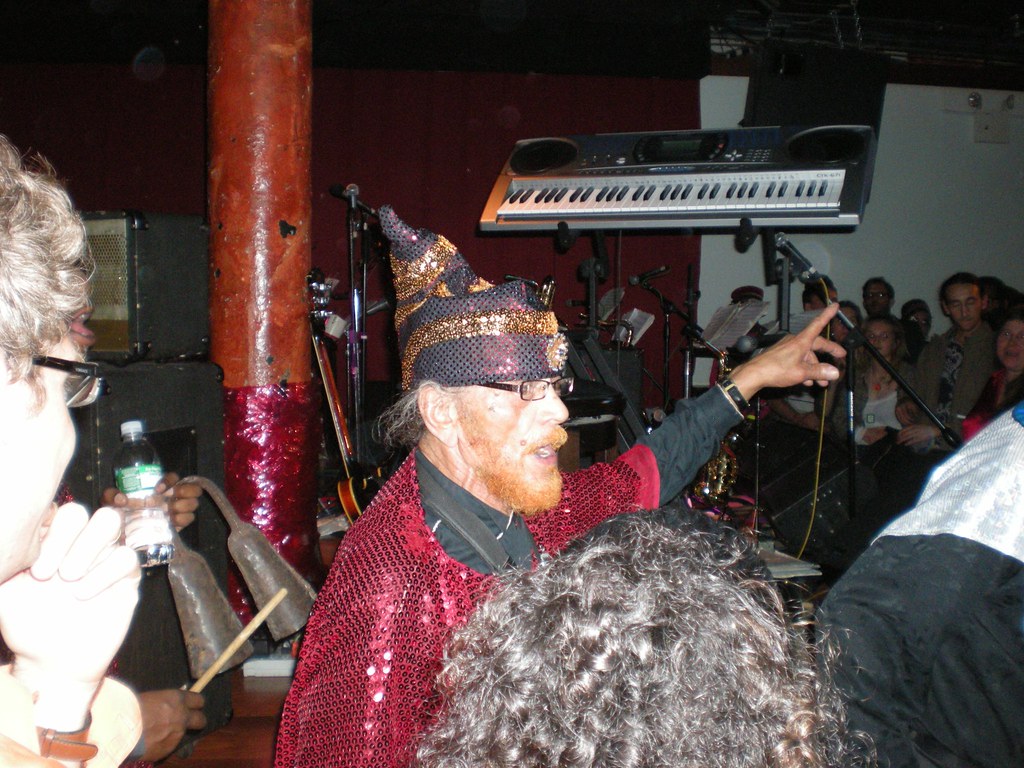
The Sun Ra Arkestra covers an astonishing slice of jazz history. Over the course of two long, spirited (and spiritual) sets at Sullivan Hall, the space age band touched upon several resonant nodes of large ensemble improvisation. Reaching all the way back into the Sun Ra catalogue with a vibrant take on "Dreams Come True" to "Space is the Place" and several wonderful Marshall Allen originals the Arkestra proved not only is it going strong, but continues to be as hip, vital and "out there" as ever. With an ensemble cohesiveness formed from unusually long associations they bring a rare ability to swing everything from standard charts to full-on free improvisation that keeps everything deliciously unpredictable and enthralling. The Arkestra also brings a playful, irreverent energy that overflows with cosmic optimism and an open invitation to bring one's ears and mind to explore a cosmos of theatrics and sound.

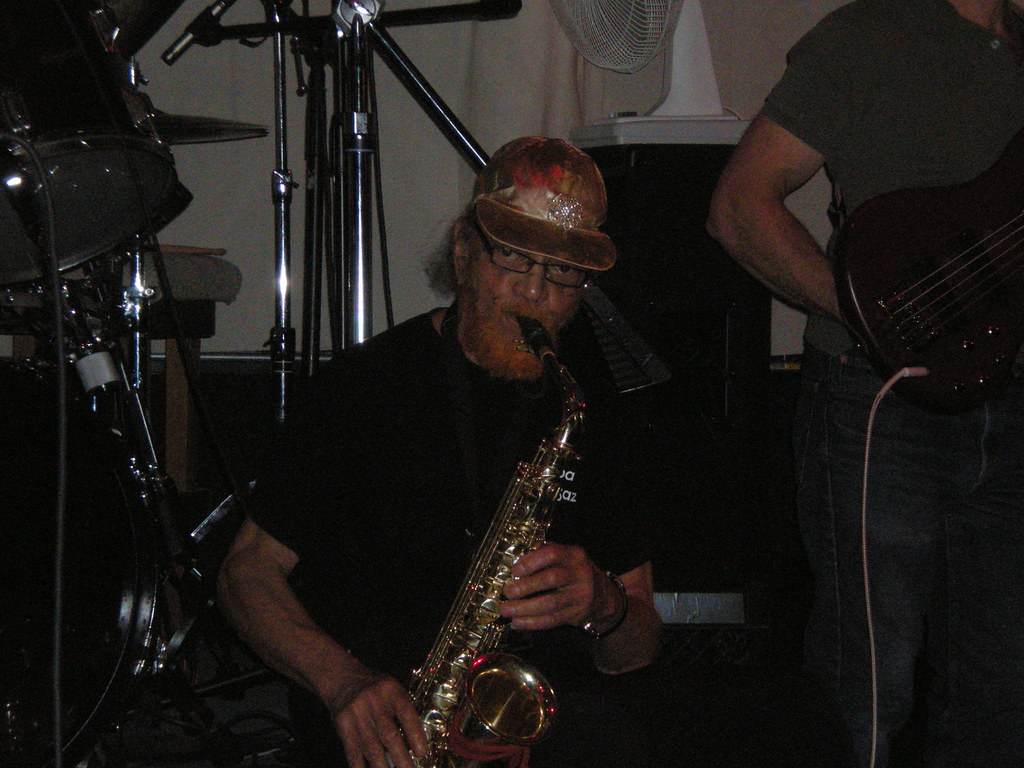
One night earlier at Baltimore's Orion Sound Studios it was a completely different sound marked by Marshall Allen's improvisational voice and searing sound. As a collaborator with Thee Maximalists, Allen was backed by the decidedly progressive rock leaning rhythm section of Paul Sears and Keith Macksoud while co-conspirators Dave Newhouse and Elliott Levin alternated as fellow horn players with keyboard and poetry added to the mix - each weaving their own individual elements into the sound. The textures often carried a heavy groove while the space-age qualities of the electronic valve instrument - a device capable of serious beauty in the hands of Marshall Allen - was completely at home within this sonic environment. The forceful gestures from the alto saxophone on display at both performances was expressively human no matter how many genres were colliding underneath it.

It's no accident that Marshall Allen led the Sun Ra horn section for 40 years before assuming the leadership position of the full Arkestra. The man from Saturn had a knack for adding - and retaining - great talents within the Arkestra. Allen's forceful gaze that sweeps across the audience with searing intensity becomes a conductive focal point when turned upon the players in the Arkestra. The combination of eyes and movement locks the ensemble together and often triggers synchronized gestures from the full battery of players. The sounds drawn out of his instruments burns with enormous creative energy. He is an excellent saxophonist and an improviser with edgy ideas that stand out. The expressions of love, respect, joy and well wishes from his colleagues and audience were genuine and heartfelt. (And the cake was delicious). At 84, his life is a fascinating story of long running creative accomplishments and a sound that deserves to be widely regarded as an important thread of jazz and creative music. His own compositional voice is a masterful take on the traditions and spirit of Sun Ra.

With Thee Maximalists, Marshall Allen proves that there are many paths both to and from Saturn. His activities outside the Arkestra add new insight to his sound as he adapts to different players with startling results. The swirling lines of the electronic valve instrument accompanied by two flutes was one particularly inspired moment within a shifting sea of improvised textures from the Maximalists. Proving that the energies of the cosmos can both rock and swing.

With the Arkestra, he resides at the helm of a beautiful pageantry. The live experience with the costumes, the sounds of joy and players clearly feeding off of the energy of a crowd is a glimpse into a friendlier solar system. The procession of players carrying their sound off the stage marked an adieu in the form of a parade easing toward a gentle return to our home planet. Earth is fortunate to have Marshall Allen among us.

Wednesday, January 02, 2008

HurdAudio Rotation: Of Mountains and Celestial Pathways

Myra Melford/Tanya Kalmanovitch: Heart Mountain. 2007. Perspicacity: PR03.

Myra Melford: piano, harmonium
Tanya Kalmanovitch: viola, violin

These 19 brief tracks flow like movements from a single work. As improvisers, Melford and Kalmanovitch frame a wide range of sonic ideas and responsiveness to each other that keeps things fresh throughout this listening experience. This is incredibly pleasant music and it's a welcome spin in the rotation.

James 'Blood' Ulmer: Birthright. 2005. Hyena Records: TMF 9335.

James 'Blood' Ulmer: vocals, guitars, flute

How does one man channel so much feeling and soul-drenched expression into a solo sound? Not only is James 'Blood' Ulmer on a first-name basis with the devil, with a blood curdling cackle to go along with such familiarity, but Ulmer can also put the dark lord in his place and make credible demands of the angels as well. With a gravelly voice and honest words about vice, deed and intention Birthright is an impressive collection of raw, beautiful blues playing.

Sun Ra: Strange Celestial Road. 1987. Rounder Records: CD 3035.

Sun Ra: keyboards
Michael Ray, Curt Pulliam, Walter Miller: trumpets
Craig Harris, Tony Bethel: trombones
Harry Wilson, Damon Choice: vibes
Richard Williams, Steve Clarke: bass
Vincent Chancy: french horn
John Gilmore, Marshall Allen, Elo Omoe, James Jacson, Danny Thompson, Kenny Williams, Hutch Jones, Sylvester Baton, Noel Scott: reeds
Luqman Ali, Reg McDonald: drums
Artaukatune: percussion
Skeeter McFarland, Taylor Richardson: guitar
June Tyson, Rhoda Blount: vocals

A much appreciated slice of Sun Ra. And on this side of the holidays the lengthy, rambling grooves with sprawling segments of "space age" poetry, free improvisation and funk is exactly the tone to bring on a new year. Hearing Vincent Chancey's horn playing within an Arkestra setting is a particular aural treat within a large ensemble stacked with outstanding (and underrated) talent. Of the vast Sun Ra catalogue, this isn't his most striking or most challenging recorded evidence. But it is a piece of the sound and journey of the Saturn soul and each face of his arrangements and large ensemble sensibility is well worth a listen.