Tickling my auditory processing system....

In much 12-tone music composition a great deal is made about suppressing octaves. The extreme 'consonance' of this interval class (the unison sharing the same interval class identification) is widely regarded as (a) being devoid of any new harmonic information as the mere duplication of the same pitch class adds color without harmony and (b) runs the risk of sounding like a reference to tonality as a cognitive "center" by placing additional weight/gravity on a single pitch class. This isn't necessarily unique to 12-tone music. Many jazz pianists learn that avoiding octaves when voicing harmonic changes makes for a more "sophisticated" sound.
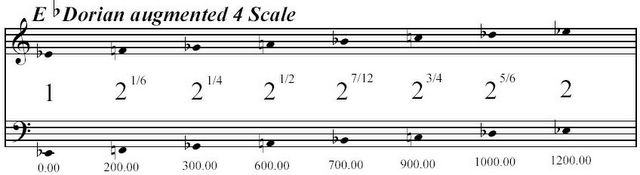
Recently I've become interested in tuning systems that naturally suppress octaves. Most scales repeat an ordered set at each octave (i.e., the "major scale" is the ordered sequence of [Major 2nd, Major 2nd, Minor 2nd, Major 2nd, Major 2nd, Major 2nd, Minor 2nd] repeating every octave between tonic pitch classes). I've been experimenting with scales that repeat at the triative (an interval 1901.96 cents wide, approximately the size of a perfect 12th) or the just perfect fifth (a 3/2, which is 701.96 cents).
I currently have my main keyboard tuned to a 3/2-based scale that sounds promising. There are a few 2/1 octaves here and there, but most of them are "off" and sound deliciously 'dissonant.' But every perfect fifth is exactly 3/2 and things resolve to that interval nicely. "Inversions" take on an interesting sonic quality as they invert relative to the perfect fifth. The major third inverts to a minor third, the inversion of a major second is the perfect fourth, etc. It's disorienting at first, but sonically logical and pleasantly other-worldly. Chromatic runs are a blast.
One of the things that makes this system intriguing is that there are many "familiar" sonic reference points. There are several 5-limit major triads (1/1, 5/4, 3/2) and 5-limit minor triads (1/1, 6/5, 3/2) mixed in with some less familiar harmonic revelations. In particular, the root position A minor triad above middle C is intoxicating (the A is tuned to an 11/8 relative to E flat, but treating the A as 1/1 the sounding triad is: 1/1, 96/77, 3/2).
So far I've been improvising with some spare, Feldman-esque textures. This is unfamiliar harmonic territory marked with several familiar-sounding landmarks so it seems natural to slowly unfold the harmonic palette over time so one can perceive the peculiarities of this other-worldly sound. The objective is to compose something that "fits" the system. Otherwise it ends up sounding "out of tune."
Having these intervals replicated at every 3/2 perfect fifth makes this system easily adaptable to non-fretted string instruments within a comfortable range of scordatura options. I could easily imagine tuning the open strings of a cello to match the notes on the re-tuned keyboard and improvising over a texture of natural glissande. Natural harmonics at 1/2, 1/4 or 3/4 of the string length would need to be "suppressed" as those are natural octaves. But the nodes at 1/3 and 2/3 would sound great.




 e is an important part of. It is a substantive and important part of American music history. This music is a valuable cultural contribution.
 How can Marshall Allen be facing such financial struggles with this kind of treasure around? There really needs to be an initiative to correct this injustice. If money can be raised to build presidential libraries then surely something could be done to properly honor the legacy of Sun Ra.